 Image 1 of 1
He Leads Her Gently: The Story Behind The Piece
The salt spray hits my face like needles in the dark. The rigging of the sailboat groans under the wind as we punch our way up the Atlantic coast, running a delivery vessel from Florida back to Charleston. I grip the cold lifeline, staring into the pitch-black ocean swell, and a reckless, hollow thought takes over: Hit a reef. Catch a rogue wave. Give me a shipwreck.
I want a physical catastrophe violent enough to match the ruin inside my skull.
Nearly a decade of my life in Charleston is decomposing behind me. I have just clawed my way out of a psychological slaughterhouse—a toxic, gaslighting cat-and-mouse dynamic with a former love that scrambled my wiring and broke my compass. I am seeking danger because danger feels honest. A desperate part of me is looking for an exit wound, looking to shred its skin and die so something else can take its place.
I survive the voyage, but survival without healing just breeds new varieties of madness.
The pendulum doesn’t just swing; it snaps off the hinges. Desperate to escape the ecosystem that poisoned me, I throw every standard, boundary, and instinct into the incinerator.
I land in a suffocating pocket of Colorado. A small town with one of everything: one indie movie theater, one Italian restaurant, one vintage resale shop, one dry cleaner.
I was a sought-after, respected filmmaker in the Southeast. Now, I drive a five-hundred-dollar minivan and park it outside an apartment that smells like stale grease. I run with the food and beverage crew, trapped in the seductive, cyclical purgatory of late nights, tips in crumpled bills, and living strictly between sunset and dawn.
I make myself tiny. I shave off my edges. I make excuses for the scarcity closing in around my throat, and I enter a relationship with an individual I wouldn’t glance at twice if I were in my right mind. He isn't my type. We share no energetic alignment, only a mutual desperation to run away from our actual lives. But to a starving person, even bitter water tastes like wine.
Then, the rot sets in.
It starts as a quiet, physical disgust. Every interaction erodes my respect for him. I watch him move across a room and feel a visceral curl of revulsion in my gut—not just toward him, but toward myself. Look at what you’ve chosen. Look at this cage you crawled into and locked from the inside.
A goldfish only grows to the size of the glass bowl it swims in. If I stay here, I will suffocate on my own scaled-down life.
November 2021. I cut the cord. I hop on a plane, back to my hometown of Austin, Texas. I need a landscape wide enough to match the fire waking back up in my chest.
A few weeks later, I am sitting around a dinner table with a group of casual acquaintances. Wine glasses, butternut squash soup, low laughter, the warm hum of new beginnings. One of the women leans forward and offers to run us through a subconscious imagery test—a psychological parlor game designed to reveal our hidden perceptions.
"Close your eyes," she says. "Picture a wide, open desert. In that desert, visualize a horse. What does it look like? What is it doing?"
Around the table, the answers are soft, lyrical, and sweet.
"Mine is a sleek palomino with a shimmery mane," one woman smiles. "It’s so friendly, walking right up to eat carrots out of my hands."
"Mine is a tall, strong white mare," another says. "Grazing peacefully under the sun."
Then, it is my turn.
The image does not drift in; it drops into my mind like a lead weight.
"Mine is a giant, black Clydesdale," I say. My voice is deadpan across the table. "He’s been decapitated. His head is served upright on a heavy silver platter, like the bedroom scene in The Godfather. And he has purple lightning swirling in his eyes—a violent, trapped vortex of a storm."
The table goes dead silent.
Someone clears their throat. The woman running the test blinks, caught between an awkward laugh and genuine alarm.
Then comes the diagnostic key: The horse represents how you perceive the masculine. It is your subconscious blueprint for romantic love.
The air leaves my lungs.
The room blurs around the edges. I am looking straight down at my cards, face up on the table, totally exposed. While these women are feeding carrots to friendly mares, I am sitting over a butcher’s block.
The truth strikes like a cold iron rod down my spine. The storm isn't out there—it is in me. After the wreckage in Charleston, after the suffocating compromise in Colorado, I haven’t been healing; I’ve been executing. I have spent months castrating, undermining, and severing the heads of every man who crossed my path. Disappearing on them. Humiliating them before they could ever draw blood on me.
The purple lightning trapped in that severed Clydesdale’s eyes is my own cynicism, spinning in an endless, contained storm of fury.
I walk out into the cool Texas night, my hands trembling. The realization is a bitter pill, but it is pure medicine.
I will not be the beheader of men.
I refuse to spend the rest of my life walking through the world with a guillotine tucked behind my back. I refuse to let old ghosts turn me into a monster.
In the quiet week that follows, I lay out paper in my studio. I reach for charcoal.
I do not draw the platter. I do not draw the blade. I sit in the stillness and listen for my true north. I ask myself what strength looks like when it no longer has to defend itself. What dynamic exists when terror is taken off the table?
My hand begins to build the forms.
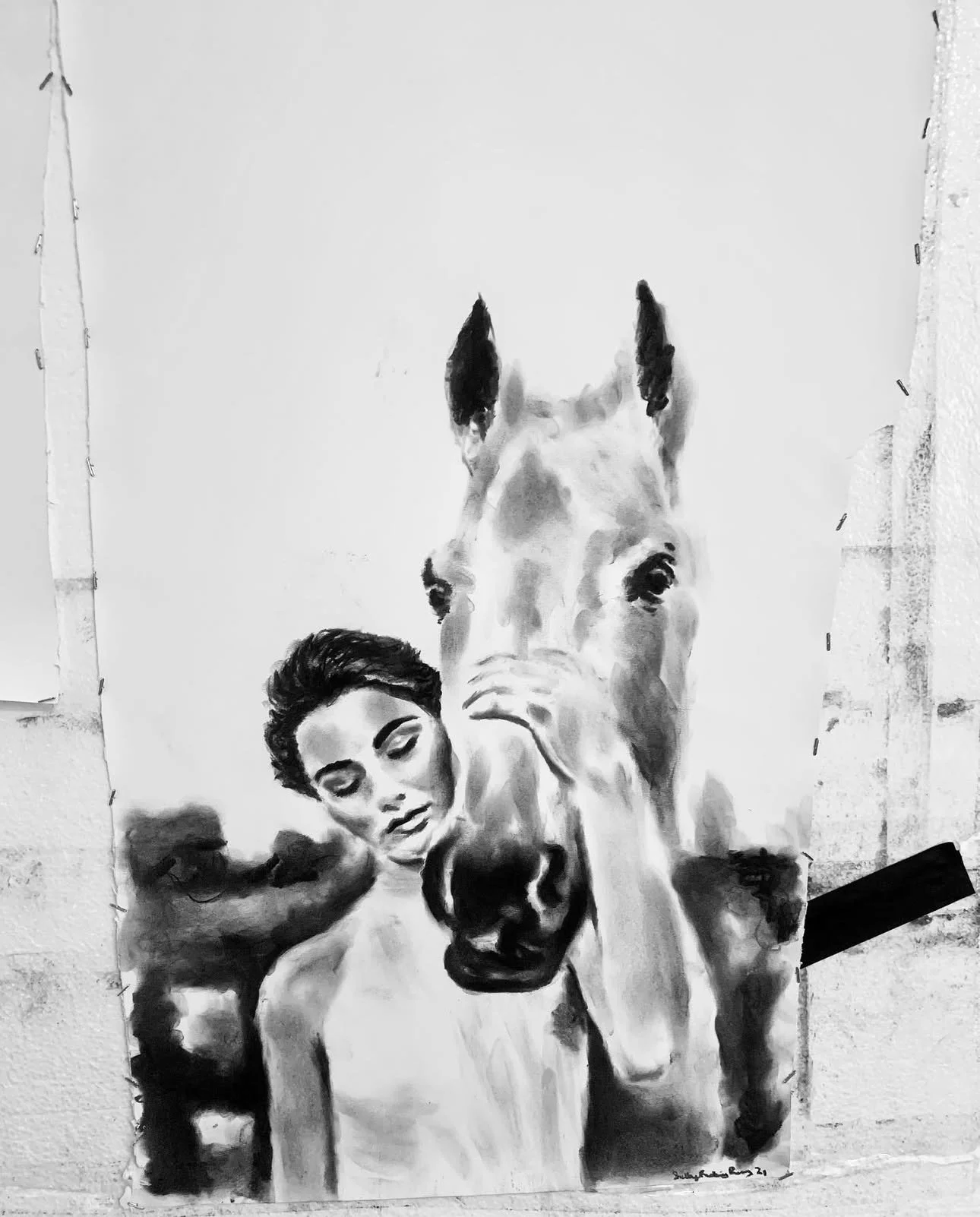
The finished piece is titled He Leads Her Gently.
It depicts a woman and a horse, bathed in an atmosphere of profound, unshakeable tranquility. There is no force here. No dominance. No severed ties. It is a massive, wild creature voluntarily lowering its head, and a woman resting in her own sovereign power, choosing stillness over slaughter. It is an image of radical trust—where she does not have to emasculate the masculine to remain safe, and he does not have to break her spirit to walk beside her.
I had to flirt with drowning in the Atlantic, crawl through the scarcity of a miniature life, and stare down the severed head of my own bitterness to finally remember what true power looks like.
May this piece always remind you that no matter how deeply betrayal has wounded you, you do not have to survive by becoming the executioner. Real strength does not conquer through fear; it anchors, protects, and allows itself to be met with radical gentleness.